New
29/03/2026
10 Essential Seed-Stage Pitch Deck Slides for 2026: The Investor Psychology Edition
The fundraising landscape of 2026 has shifted. The era of "growth at all costs" is dead, replaced by a ruthless focus on capital efficiency and sustainable moats. For a Seed-stage founder, your pitch deck is no longer just a presentation; it is a psychological roadmap that must lead an investor to one inevitable conclusion: This team is the only one capable of winning this market.
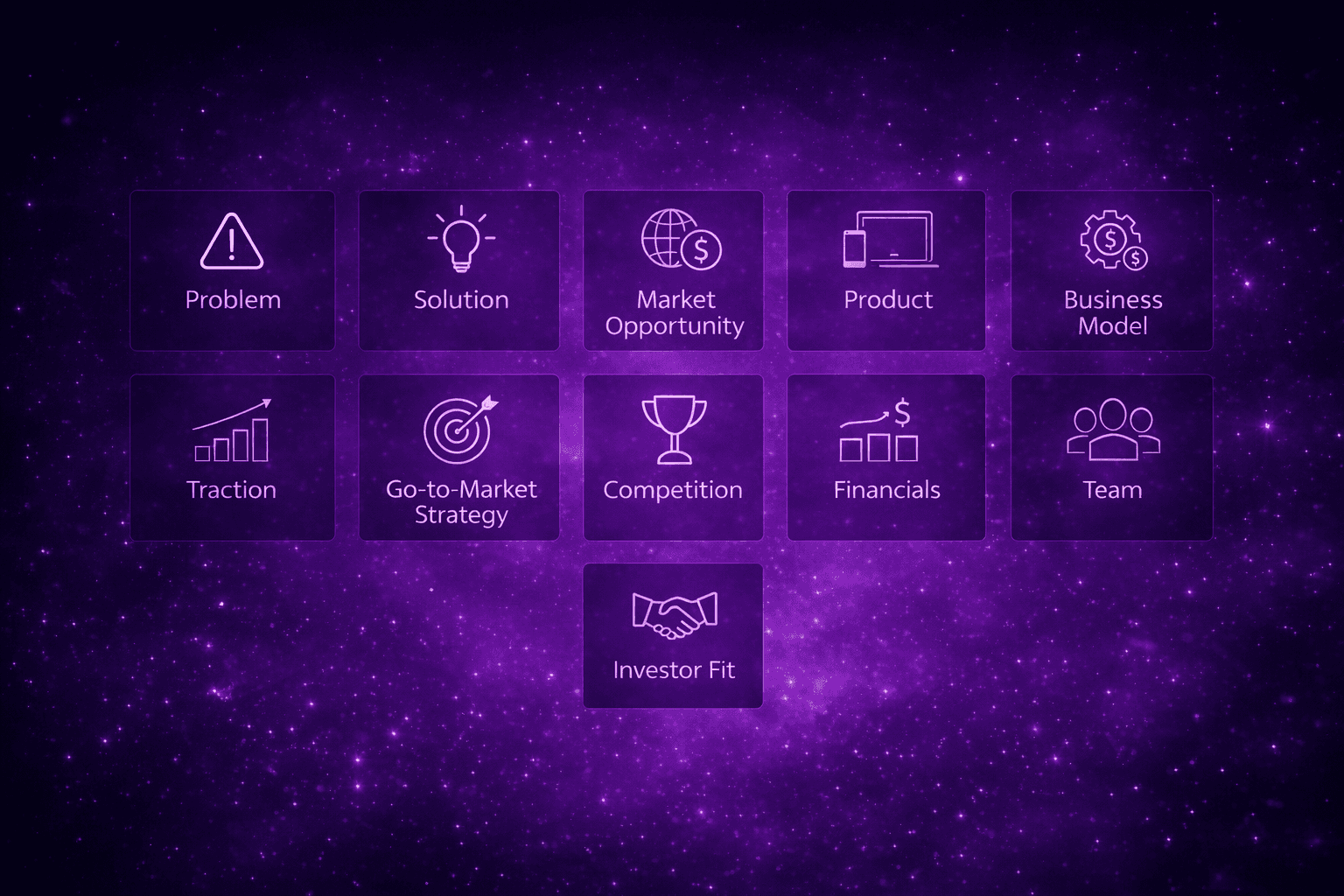
At Pitch Rex, we’ve analyzed thousands of investor interactions to develop a 90% 2nd-meeting rate. What we’ve learned is that investors don’t just read slides; they look for signals. Here is the 10-slide blueprint for a Seed round pitch deck that satisfies the modern investor’s psychology.
The Vision Slide: The "10-Second" Hook
Most founders waste the first slide on a generic "Hello, we are X." In 2026, you have exactly 10 seconds before an investor starts scrolling.
The Psychology: You need to anchor their brain in a massive "What If."
The Insight: Use one bold sentence that defines the future you are building. It shouldn't be about your product; it should be about the change your product creates.
Internal Link: This is where our Story Architecture begins—setting the stage for a high-stakes narrative.
he "Why Now" Slide: The Catalyst
Investors are terrified of "right idea, wrong time." Why didn't this exist three years ago? Why can't it wait three more?
The Psychology: This slide creates urgency. You must identify a specific "inflection point"—a regulatory change, a technological breakthrough (like advancements in edge AI), or a massive shift in consumer behavior.
The Insight: If you can’t prove the "Why Now," the investor will default to "Wait and See."
The Team Slide: The "Bet on the Jockey"
At the Seed stage, your product is likely to pivot. Your team is the only constant. We recommend moving this to Slide 3, rather than the end.
The Psychology: Investors are looking for "Founder-Market Fit." They want to know why your specific background makes you uniquely qualified to solve this problem.
The Insight: Don't just list logos of where you worked. Highlight "earned secrets"—insights you have that the rest of the market doesn't.
The Team Slide: The "Bet on the Jockey"
At the Seed stage, your product is likely to pivot. Your team is the only constant. We recommend moving this to Slide 3, rather than the end.
The Psychology: Investors are looking for "Founder-Market Fit." They want to know why your specific background makes you uniquely qualified to solve this problem.
The Insight: Don't just list logos of where you worked. Highlight "earned secrets"—insights you have that the rest of the market doesn't.
The Solution Slide: The "Aha!" Moment
This is where you introduce your product, but keep it high-level.
The Psychology: Relief. The solution should feel like the only logical answer to the problem you just described.
The Insight: Focus on the "Magic Moment"—the one thing your product does that makes a user never want to go back to the old way. This is the heart of a professional pitch deck design.
The Market Slide: Beyond the TAM Cliché
Investors are tired of seeing a $50B TAM (Total Addressable Market) slide with a circle around it. It’s lazy and unconvincing.
The Psychology: Credibility. Show them your SOM (Serviceable Obtainable Market)—the actual revenue you can capture in the next 24 months.
The Insight: Break down your market by segments. Show that you understand exactly who your first 1,000 "power users" are.
The Traction Slide: Proof of Momentum
Traction isn't just revenue. At the Seed stage, it’s about "signals of intent."
The Psychology: FOMO (Fear Of Missing Out). You want the investor to feel like the train is already leaving the station and they are just deciding whether to hop on.
The Insight: Highlight your Financial Narrative. Show month-over-month growth, waitlist numbers, or pilot programs with reputable brands.
The Competition Slide: The Defensibility Moat
Never say "we have no competition." It tells an investor that there is no market or that you haven't done your homework.
The Psychology: Security. Prove that even if a giant like Google or Amazon enters the space tomorrow, you have a "moat" (data network effects, proprietary IP, or deep integration) that protects you.
The Insight: Use a "Product Landscape" map rather than a simple checklist of features. Show where you sit in the ecosystem.
The Market Slide: Beyond the TAM Cliché
In 2026, VCs look for "unit economics" early. They want to see that for every $1 they give you, you have a clear path to turning it into $5.
The Psychology: Competence. You need to show you aren't just a "builder," but a "business operator."
The Insight: This is the most critical part of your fundraising narrative strategy. Focus on your CAC (Customer Acquisition Cost) vs. LTV (Lifetime Value) projections.
The Ask: The Strategic Milestone
The final slide shouldn't just be a number. It should be a plan.
The Psychology: Partnership. You aren't asking for a "donation"; you are offering an opportunity to fund a specific set of milestones.
The Insight: Instead of saying "We are raising $2M," say "We are raising $2M to reach 10k MRR and hire 3 key engineers." Be specific about what the capital unlocks.
Why a "Startup Fundraising Template" Isn't Enough
If you search for a startup fundraising template, you’ll find thousands of free PowerPoints. The problem? Those templates don't include the Investor Psychology required to survive a 2026 due diligence process.
A template is a skeleton; Pitch Rex provides the soul, the strategy, and the narrative that makes a deck "reign" in the inbox of a VC. Whether you need a Deck Audit & Review to fix a leaking funnel or a Full Pitch Deck Development from scratch, the goal is the same: Get the "Yes."
Conclusion: Every Word Must Earn Its Place
Investors spend an average of 3 minutes and 44 seconds on a pitch deck. If your slides are cluttered with "pretty" graphics that don't serve a strategic purpose, you are wasting valuable seconds.
By focusing on Investor Presentation logic rather than just aesthetics, you move from being a "founder with an idea" to a "leader with a plan." If you're on a tight timeline and need to move fast, our Express Deck - 48HR service ensures you don't sacrifice this psychology for speed.
Ready to turn your vision into a funded reality? Book a Call with Pitch Rex today.
At Pitch Rex, we’ve analyzed thousands of investor interactions to develop a 90% 2nd-meeting rate. What we’ve learned is that investors don’t just read slides; they look for signals. Here is the 10-slide blueprint for a Seed round pitch deck that satisfies the modern investor’s psychology.
The Vision Slide: The "10-Second" Hook
Most founders waste the first slide on a generic "Hello, we are X." In 2026, you have exactly 10 seconds before an investor starts scrolling.
The Psychology: You need to anchor their brain in a massive "What If."
The Insight: Use one bold sentence that defines the future you are building. It shouldn't be about your product; it should be about the change your product creates.
Internal Link: This is where our Story Architecture begins—setting the stage for a high-stakes narrative.
he "Why Now" Slide: The Catalyst
Investors are terrified of "right idea, wrong time." Why didn't this exist three years ago? Why can't it wait three more?
The Psychology: This slide creates urgency. You must identify a specific "inflection point"—a regulatory change, a technological breakthrough (like advancements in edge AI), or a massive shift in consumer behavior.
The Insight: If you can’t prove the "Why Now," the investor will default to "Wait and See."
The Team Slide: The "Bet on the Jockey"
At the Seed stage, your product is likely to pivot. Your team is the only constant. We recommend moving this to Slide 3, rather than the end.
The Psychology: Investors are looking for "Founder-Market Fit." They want to know why your specific background makes you uniquely qualified to solve this problem.
The Insight: Don't just list logos of where you worked. Highlight "earned secrets"—insights you have that the rest of the market doesn't.
The Team Slide: The "Bet on the Jockey"
At the Seed stage, your product is likely to pivot. Your team is the only constant. We recommend moving this to Slide 3, rather than the end.
The Psychology: Investors are looking for "Founder-Market Fit." They want to know why your specific background makes you uniquely qualified to solve this problem.
The Insight: Don't just list logos of where you worked. Highlight "earned secrets"—insights you have that the rest of the market doesn't.
The Solution Slide: The "Aha!" Moment
This is where you introduce your product, but keep it high-level.
The Psychology: Relief. The solution should feel like the only logical answer to the problem you just described.
The Insight: Focus on the "Magic Moment"—the one thing your product does that makes a user never want to go back to the old way. This is the heart of a professional pitch deck design.
The Market Slide: Beyond the TAM Cliché
Investors are tired of seeing a $50B TAM (Total Addressable Market) slide with a circle around it. It’s lazy and unconvincing.
The Psychology: Credibility. Show them your SOM (Serviceable Obtainable Market)—the actual revenue you can capture in the next 24 months.
The Insight: Break down your market by segments. Show that you understand exactly who your first 1,000 "power users" are.
The Traction Slide: Proof of Momentum
Traction isn't just revenue. At the Seed stage, it’s about "signals of intent."
The Psychology: FOMO (Fear Of Missing Out). You want the investor to feel like the train is already leaving the station and they are just deciding whether to hop on.
The Insight: Highlight your Financial Narrative. Show month-over-month growth, waitlist numbers, or pilot programs with reputable brands.
The Competition Slide: The Defensibility Moat
Never say "we have no competition." It tells an investor that there is no market or that you haven't done your homework.
The Psychology: Security. Prove that even if a giant like Google or Amazon enters the space tomorrow, you have a "moat" (data network effects, proprietary IP, or deep integration) that protects you.
The Insight: Use a "Product Landscape" map rather than a simple checklist of features. Show where you sit in the ecosystem.
The Market Slide: Beyond the TAM Cliché
In 2026, VCs look for "unit economics" early. They want to see that for every $1 they give you, you have a clear path to turning it into $5.
The Psychology: Competence. You need to show you aren't just a "builder," but a "business operator."
The Insight: This is the most critical part of your fundraising narrative strategy. Focus on your CAC (Customer Acquisition Cost) vs. LTV (Lifetime Value) projections.
The Ask: The Strategic Milestone
The final slide shouldn't just be a number. It should be a plan.
The Psychology: Partnership. You aren't asking for a "donation"; you are offering an opportunity to fund a specific set of milestones.
The Insight: Instead of saying "We are raising $2M," say "We are raising $2M to reach 10k MRR and hire 3 key engineers." Be specific about what the capital unlocks.
Why a "Startup Fundraising Template" Isn't Enough
If you search for a startup fundraising template, you’ll find thousands of free PowerPoints. The problem? Those templates don't include the Investor Psychology required to survive a 2026 due diligence process.
A template is a skeleton; Pitch Rex provides the soul, the strategy, and the narrative that makes a deck "reign" in the inbox of a VC. Whether you need a Deck Audit & Review to fix a leaking funnel or a Full Pitch Deck Development from scratch, the goal is the same: Get the "Yes."
Conclusion: Every Word Must Earn Its Place
Investors spend an average of 3 minutes and 44 seconds on a pitch deck. If your slides are cluttered with "pretty" graphics that don't serve a strategic purpose, you are wasting valuable seconds.
By focusing on Investor Presentation logic rather than just aesthetics, you move from being a "founder with an idea" to a "leader with a plan." If you're on a tight timeline and need to move fast, our Express Deck - 48HR service ensures you don't sacrifice this psychology for speed.