New
29/03/2026
Pitch Deck Design vs. Pitch Deck Strategy
There is a common, expensive mistake made by founders in the early stages of a fundraise: they assume that a "great" pitch deck is defined by how it looks. They spend weeks obsessing over color palettes, typography, and high-resolution imagery, believing that a polished aesthetic will signal professional competence to an investor.
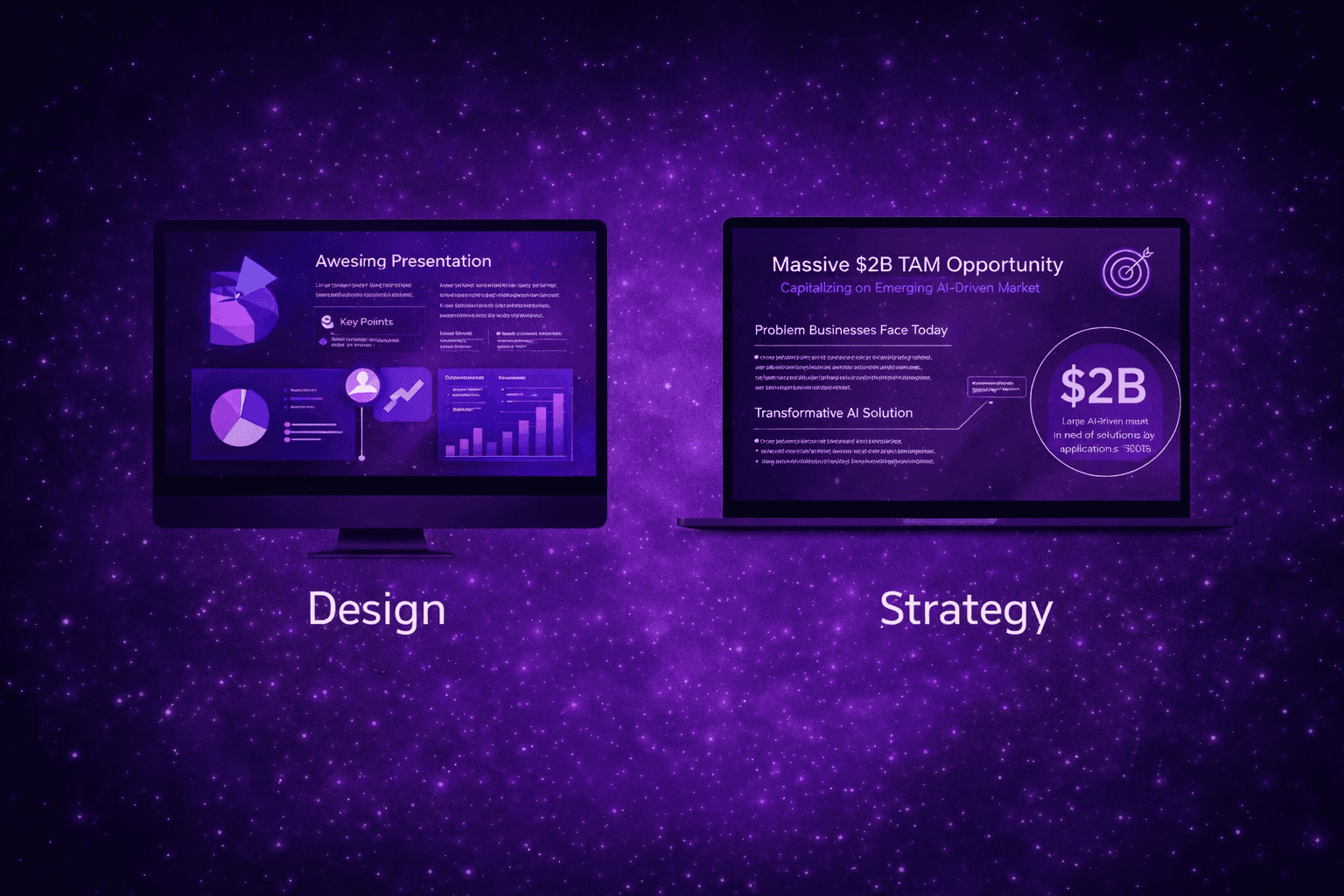
But here is the reality from the other side of the table: An investor doesn’t write a check because your slides are beautiful. They write a check because your business logic is undeniable. In the high-stakes world of venture capital, "pretty" is a commodity. You can find a graphic designer on any freelance marketplace to make a deck look professional for a few hundred dollars. But a graphic designer is not a fundraising narrative strategy expert. There is a fundamental difference between a deck that looks good and a deck that works. At Pitch Rex, we focus on the latter, which is why our clients have seen a 90% 2nd-meeting rate.
The Cognitive Load Trap: Why "Over-Design" Kills Deals
The most dangerous thing a pitch deck can do is confuse an investor. When a slide is over-designed—filled with complex gradients, overlapping graphics, and distracting animations—it increases "cognitive load." This is the amount of mental effort required to process information.
If a VC has to work to understand your slide, you have already lost them. A professional pitch deck design should act as a transparent window into your business logic. It shouldn't be the main attraction; it should be the support system for a conversation.
Strategy-first design uses visual hierarchy to tell the investor’s eyes exactly where to look first. It prioritizes the "so what?" over the "how it looks." If your "Solution" slide is a masterpiece of graphic design but fails to explain the core value proposition in three seconds, it is a failure of strategy.
The Skeleton vs. The Skin: What is Story Architecture?
Think of your pitch deck like a building. The design—the colors, the glass, the furniture—is the "skin." But without a "skeleton," the building collapses. In fundraising, that skeleton is what we call Story Architecture.
A pitch deck consultant doesn't start with a blank slide in Canva. They start with a spreadsheet and a whiteboard. They map out the narrative arc:
The Hook: Establishing the massive opportunity.
The Tension: Defining the friction in the current market.
The Resolution: Proving your product is the only logical answer.
The Proof: Validating that you are the team to execute it.
When you hire a designer, you are paying for the "skin." When you invest in a fundraising narrative strategy, you are paying for the architecture. It is the difference between a pretty house and a house that can withstand a hurricane of investor due diligence.
The "Financial Narrative": Beyond the Charts
Perhaps the biggest divide between design and strategy is found on the "Financials" and "Traction" slides. A designer will take your numbers and put them in a clean bar chart. A strategist will look at those numbers and ask: "Does this chart prove that your unit economics are scalable?"
A Financial Narrative isn't just about showing that "up and to the right" line. It’s about explaining why the line is moving. It’s about showing the relationship between your Customer Acquisition Cost (CAC) and your Lifetime Value (LTV). It’s about proving capital efficiency.
Investors are looking for "Institutional Insights." They want to see that you understand the levers of your own business. If your deck looks like a billion-dollar company but your financial narrative sounds like a hobbyist, the "pretty" slides will only highlight the lack of depth.
Why a "Deck Audit" Is the Best Starting Point
Many founders come to us with a deck they’ve already spent thousands of dollars on with a design agency. On the surface, it looks spectacular. But they aren't getting past the first email.
This is why we offer a Deck Audit & Review as an entry point. We look at your deck through an "investor lens." We don't care about the font; we care about the "earned secrets." We look for:
Narrative Gaps: Where does the story break?
Objection Handling: Are you answering the investor's biggest fears before they ask?
Market Realism: Is your market size credible or a cliché?
Often, a few strategic tweaks to the order of the slides or the wording of a headline can do more for your fundraise than a total visual redesign ever could.
Moving from an "Artifact" to an "Asset"
Your pitch deck should not be a static artifact that you "finish" and send out. It is a living asset. A strategist builds a deck that is modular—something you can adapt for a Seed round, a Series A, or a specific meeting with a Tier-1 VC.
When you choose strategy over just design, you aren't just buying a PDF. You are buying the confidence that comes from knowing your narrative is airtight. You are buying the ability to stand in a room (or on a Zoom call) and know that every slide behind you is working to earn that next meeting.
With over $2.2B raised by our clients, we know that the "secret sauce" isn't a better hex code for your brand colors. It’s a deeper understanding of what makes an investor say "Yes."
Conclusion: Don't Decorate a Weak Story
If you are preparing for a high-stakes fundraise, ask yourself: "Am I trying to look the part, or am I trying to win the deal?" Design is essential, but it must be the servant of strategy. Don't decorate a weak story. Build a Full Pitch Deck that starts with the truth of your business and uses design to make that truth impossible to ignore.